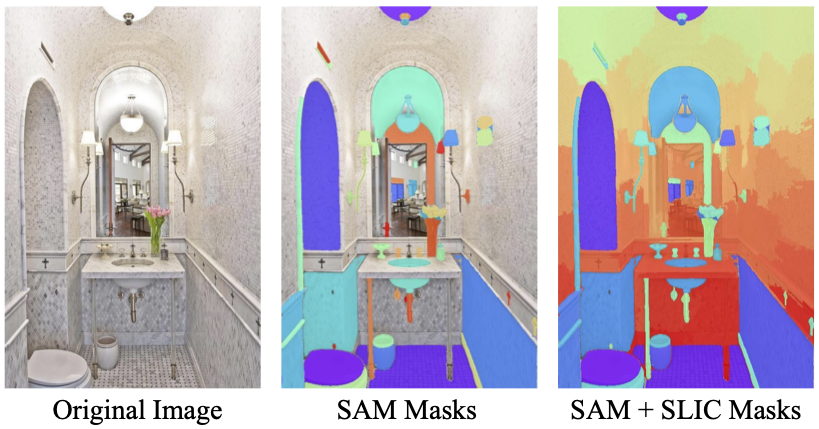
Region representations were popular before deep learning. What happens when we build them from recent foundation models? A simple region-based method performs well on existing tasks, such as semantic segmentation, and on new ones.
I am a machine-learning researcher working on vision–language models, continual learning, and video understanding. I currently consult on machine learning for Food MarketMaker, a national food-system network developed at the University of Illinois, where I build a human-supervised self-improvement loop for its LLM search assistant. I have also consulted for the U.S. Naval Research Laboratory.
From 2024 to 2025 I was a postdoctoral fellow in Computer Science at the University of Illinois Urbana-Champaign, co-advised by Derek Hoiem and Heng Ji, where I led research for the DARPA ECOLE program. Before that, I built the machine-learning capability at Reconstruct.
I am a civil engineer by training. After nearly seven years designing structures and managing construction in Peru, I earned an M.S. and a Ph.D. in Civil Engineering at Illinois with Mani Golparvar-Fard, along with an M.C.S. My bachelor's degree is from the Pontificia Universidad Católica del Perú.
My research spans computer vision, multimodal learning, and continual learning, with emphasis on systems that operate over long time horizons. My work includes:
My background in civil engineering and computer science shapes how I model physical environments, structured geometry, and dynamic processes, and how I build vision systems that are robust and interpretable.
Region representations were popular before deep learning. What happens when we build them from recent foundation models? A simple region-based method performs well on existing tasks, such as semantic segmentation, and on new ones.
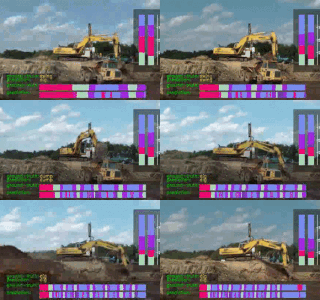
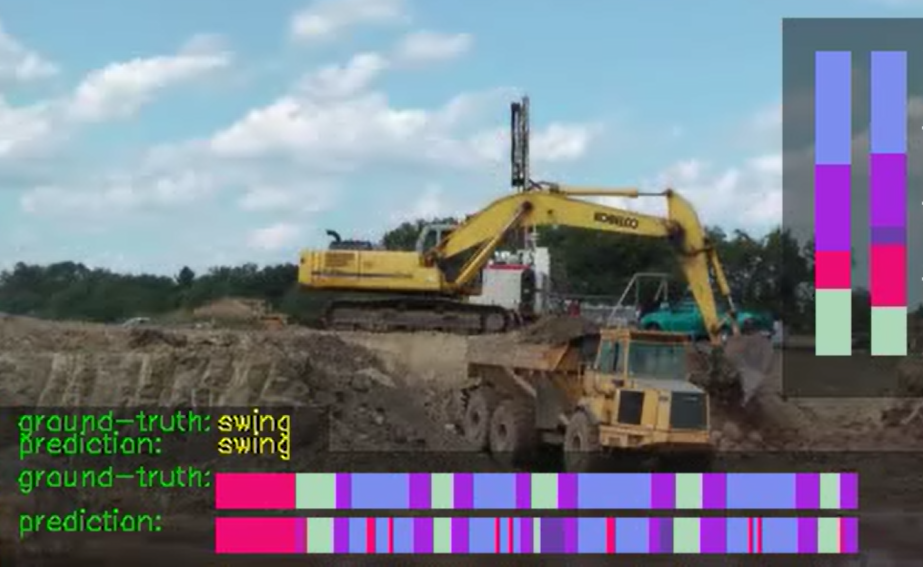
A vision-based activity analysis method trained on synthetic hauling operations generated from 3D simulations.
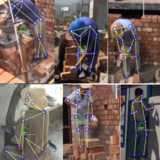
A vision-based activity analysis method built on 2D pose estimates, the same outputs many construction-ergonomics methods use.
An NLP model that maps raw construction-schedule activities to 3D BIM elements.
A 2D human-pose annotation tool, adapted from CVAT, that also annotates per-frame activity labels.